
Madurai: The Madras High Court has issued an important order on the entry of non-Hindus into specific temples in Tamil Nadu that follow Agama traditions, requiring visitors to affirm their faith in the presiding deity and respect for the temple’s customs and religious practices.
According to reports, the requirement, which was earlier applicable to non-Hindus seeking to cross the temple’s kodimaram (flagstaff) and enter the inner areas, has now been extended to the entire temple premises. Those wishing to enter such temples must submit a declaration in the prescribed format affirming their devotion to the deity and respect for the institution’s religious traditions.
A division bench comprising Justices G.R. Swaminathan and P. Murugan passed the order while hearing a public interest litigation concerning the protection of temple sanctity and adherence to Agama rules.
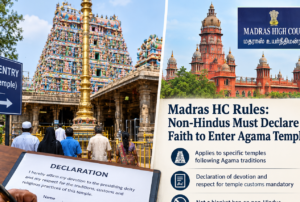
The order marks a change in the reported entry procedure. Previously, non-Hindus were required to sign a declaration only when they intended to cross the flagstaff and proceed further into the temple. The revised direction extends the requirement to the temple premises as a whole, according to the details available.
However, the ruling does not impose a blanket ban on non-Hindus entering temples. Instead, it provides for entry subject to the declaration requirement, under which visitors affirm their devotion to the deity and respect for the temple’s established customs.
The scope of the order is also limited. It applies to specific temples that conduct worship in accordance with Agama traditions and should not be interpreted as a rule covering every temple in Tamil Nadu.
The decision is expected to affect entry procedures at the temples covered by the directive. Its implementation will depend on the applicable Agama practices and the precise terms of the court’s order.
The ruling brings the relationship between religious traditions, temple administration and access for visitors into focus, while leaving the distinction between Agama-governed temples and other religious institutions important to its interpretation.


