New York: India has strongly opposed proposals to create a new category of permanent members in the United Nations Security Council (UNSC) without veto powers, warning that such an arrangement would relegate newly inducted countries to “second-class” status while preserving the dominance of the existing five permanent members.
Speaking during a UN General Assembly debate on veto powers on Monday, India’s permanent representative to the United Nations, Ambassador Harish Parvathaneni, said meaningful Security Council reform must ensure fairness and equality among permanent members.
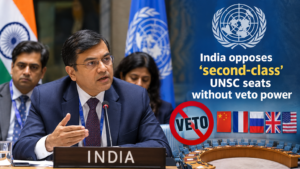
India reiterated its position that as long as the veto continues to exist, all permanent members of a reformed Security Council must enjoy the same privilege. Creating a separate category of long-term members without veto powers would not fundamentally alter the existing decision-making structure, he argued.
The 15-member Security Council currently comprises five permanent members — China, France, Russia, the United Kingdom and the United States — which possess veto powers, alongside 10 non-permanent members elected for two-year terms.
Established in 1945, the Council’s composition has long faced criticism for failing to reflect contemporary geopolitical realities. India has consistently argued that the body needs comprehensive reform to make it more representative and effective in addressing the challenges of the 21st century.
New Delhi has called for an expansion of both permanent and non-permanent membership, maintaining that increasing only the number of non-permanent seats would not constitute meaningful reform. India has also been campaigning for a permanent seat on the Council.
Separately, India is seeking election as a non-permanent member for the 2028–29 term. It will compete against Tajikistan for the single seat allocated to the Asia-Pacific group, with the election scheduled for June 2027.
India last served on the Security Council during the 2021–22 term, its eighth stint on the body. Its previous terms were 1950–51, 1967–68, 1972–73, 1977–78, 1984–85, 1991–92 and 2011–12.
India’s position remains that any reformed Council must ensure equal rights and responsibilities for all permanent members for as long as veto powers remain in place.